
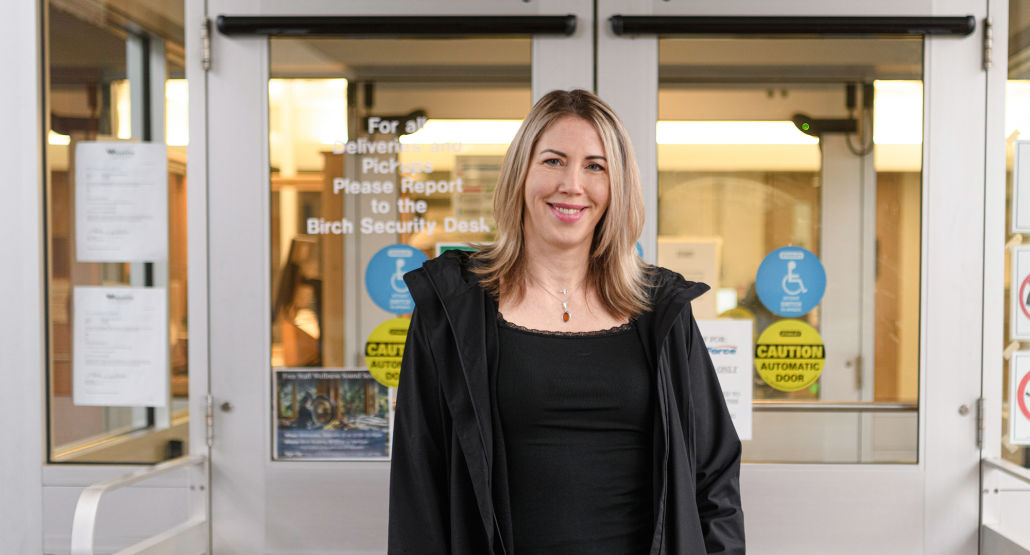
Magdalena Kowalska-Villarroel
Behind the locked doors of BC’s only forensic psychiatric hospital, one pharmacist is helping some of the province’s most complex patients find their way back to stability.
Words by Jessica Natale Woollard Photos by Aaron Lutsch
Steps from where the Coquitlam River empties into the Fraser, at the southern tip of ƛ̓éxətəm Regional Park (formerly known as Colony Farm Regional Park), sits the secure compound of British Columbia’s Forensic Psychiatric Hospital (FPH). Beyond the chain-link fencing is a campus of several buildings where treatment is provided to up to 190 mostly involuntary patients from around the province who have been found by BC courts to be either (1) not criminally responsible for a crime or (2) unfit to stand trial due to a mental disorder.
It’s a workplace like no other, operating at the intersection of health care and the justice system. Psychiatrists, psychologists, pharmacists, social workers, nurses and other health professionals work in partnership to provide complex psychological care, while forensic services officers provide security and keep staff and patients safe. At FPH, compassion must be balanced with custody; trauma-informed medical care coexists with locked units and security protocols.
A hospital pharmacist, Professional Employees Association member Magdalena Kowalska-Villarroel lends her expertise on the FPH’s clinical healthcare team. Part of the Health Science Professionals Bargaining Association—along with just eight other PEA pharmacists—she provides treatments that help patients stabilize and, if possible, return to their lives.
“A lot of patients come [to FPH] when they’re quite unstable. They have committed offences linked to symptoms of severe mental illness,” Kowalska-Villarroel explains. “After their stay here, many patients are completely turned around. You can see how much of a difference medications and proper medication management can make. It’s a life changer for a lot of patients.”
Most FPH patients live with complex mental health issues, frequently a psychotic disorder such as schizophrenia. Often, their disorder coexists with another, such as a mood or personality disorder like post-traumatic stress disorder or borderline personality disorder. Sometimes, addiction is the comorbid condition. Many arrive for short stays, transferred from correctional centres for assessment or treatment under BC’s Mental Health Act. Others reside at the hospital for months or years, until they are treated with therapy and medications and, once recovered, can slowly and carefully reintegrate into their families and society while supported by FPH outpatient services. Still others will remain at FPH for life.
With medication therapy playing a key role in the treatment and stabilization of complex mental illnesses, Kowalska-Villarroel’s contributions are vital to the care provided at FPH. As a hospital pharmacist, she serves as an active decision-maker on the clinical healthcare team. Her work includes recommending, reviewing and monitoring medications and doses; making adjustments where needed; and ensuring the medication is working safely and effectively for the patient during their stay and once discharged. Along with the team of pharmacists, she helps to prevent errors in prescribing by managing the dispensing of drugs, overseeing inventory and ensuring proper storage and stability. She also participates in ward rounds and patient care meetings and educates residents on their medications.
“You see how much support the patients need,” she reflects. “[Their illness] is a struggle for them; it’s not something they chose. It’s just so rewarding to be part of their recovery stories.” Sadly, she adds, “not all cases are recovery stories.”
Some of the duties of a hospital pharmacist overlap with those of a traditional community pharmacist, such as drug distribution and verification, but Kowalska-Villarroel’s presence on the hospital clinical team means she has more information to work with and can consult patients’ histories and test results to make better decisions about what medications to use for each patient. This advantage is part of what prompted her to depart community pharmacies after 12 years. She started her career in community pharmacies, working for two years as a pharmacist and then a decade as a pharmacy manager.
The graduate of the University of British Columbia’s pharmacy program made her first move into hospitals in 2018, taking a position with Fraser Health at a clinic in Vancouver’s Downtown Eastside (DTES). The site operated as an embedded ambulatory clinic pharmacy located inside a medical clinic, giving Kowalska-Villarroel her first experience working collaboratively with other health care professionals. Together, the team oversaw pharmaceutical treatments and education for street-entrenched clients living with substance use disorders.
Her experience on the DTES gave rise to a desire to focus on psychiatric care. In 2021, Kowalska-Villarroel accepted her role at FPH, as well as a casual pharmacist position at Eagle Ridge Hospital, a small acute-care hospital in Port Moody.
In addition to splitting her time between the two hospitals, Kowalska-Villarroel serves as a member-at-large on the executive of the PEA’s Health Science Professionals Chapter. She joined to ensure “pharmacists have a voice in decisions that directly affect our work and our patients,” she says.
With significant support from Idil Farah, a labour relations officer for the PEA, Kowalska-Villarroel played a role in securing forensic pay premiums for pharmacists at FPH, in recognition of the site’s specialized nature and associated risks. The forensic pay was implemented in April 2026.
“For me, union involvement is not just about helping achieve fair compensation for members,” says Kowalska-Villarroel. “It’s about safety, equity and ensuring pharmacists are recognized and supported, so we can focus on what matters most: our patients.”
Helping FPH patients rebuild their lives after the serious and often heartbreaking situations that led to their admission is what Kowalska-Villarroel finds most meaningful about her work.
“Most of the offences [that have resulted in interactions with the justice system] happen because of untreated mental illness,” she says, noting that many patients come with past traumas that never healed and, especially in the case of female patients, often arrive in acute states of vulnerability. Because the events that led to a patient’s admittance to FPH frequently involve harm to a family member, many patients, once treated, “feel deep remorse for what happened and struggle with profound guilt, shame, stigma and depression,” she continues.
The situation is traumatic for the whole family, but despite the harm done, “many of our patients are really deeply loved by their families. There are strong family bonds; parents come visit, they send gifts and medications. They’re very involved with the care of their loved ones.”
Kowalska-Villarroel recalls a patient with a complex neuropsychiatric disorder whose story ended well. The individual had been involved in a serious incident and was later transferred to FPH for assessment and treatment. “With the help of medications, our patient made meaningful progress in their recovery. They were able to work again and reconcile with their family,” she recounts.
If a patient like this one is doing well enough to be discharged from the hospital, they will first move into supervised housing in their home community in BC. Outpatient services follow their progress carefully, ensuring they continue to take their medication as prescribed and continue with treatment plans. If all goes well, they will eventually be able to return to their families and their lives.
A return to a stable life is what Kowalska-Villarroel hopes for every patient, though it is not possible for everyone. She approaches each case with care, compassion and respect for the person behind the illness.
“They’re someone’s child, someone’s spouse, someone’s mom. We work with these people in the most difficult moments in their life,” she says. “You can see how a little bit of heart makes a huge difference. We can help them regain their dignity and start rebuilding their future.”
See article in the Professional, Spring 20026
