
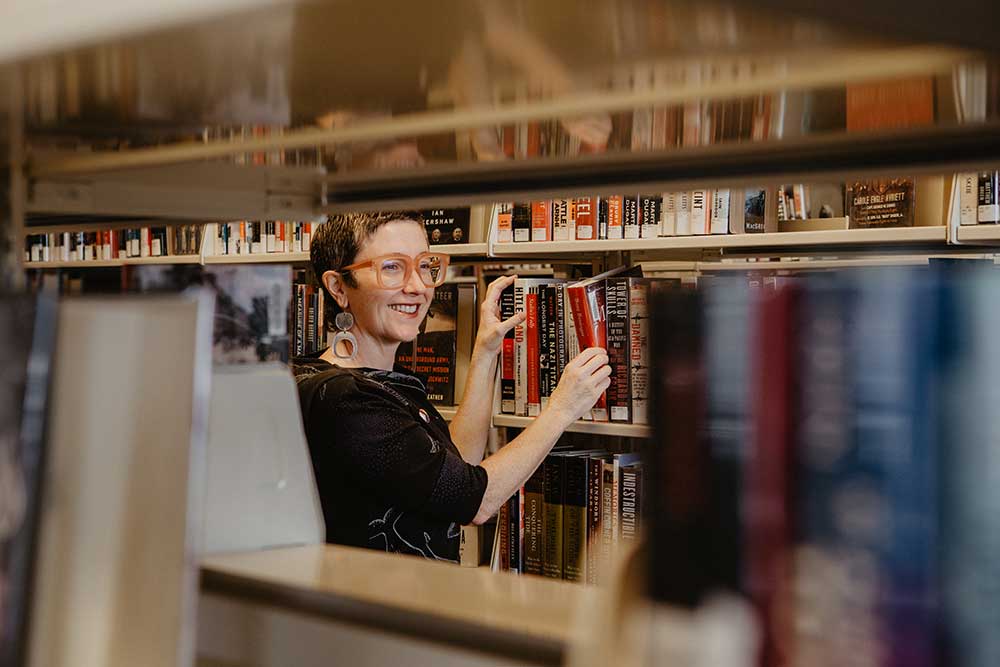
Kristy Hennings
Your Library, Your Way: Vernon Branch Head, Kristy Hennings, delivers library service that follows the community’s lead
Words by Jessica Natale Woollard, Photos by Alana Dubrule
In a soundproof recording studio, an 11-year-old boy inspects the professional equipment: the condenser microphone, headphones, monitors, and specialty software.
He is dreaming of what is possible; mapping out his return to the studio with his instruments and plotting his first recording—he’ll use it to study his sound and hone his craft.
The recording studio is surrounded by a hive of activity. Budding illustrators use graphic design programs to produce digital art. Amateur genealogists make digital copies of precious family records. Scrapbookers manipulate laser cutters to make precise shapes for paper crafts. Career-oriented young adults take courses on LinkedIn Learning. And older adults new to technology practice downloading e-audiobooks and digital newspapers.
The best part? It’s all free with a library card.
A fundamental reason libraries have existed for centuries is to provide equitable access to information and knowledge which, today, extends beyond what is conveyed in print or even words.
“Libraries are adding technology because a lot of folks can’t afford to purchase expensive equipment,” explains Kristy Hennings, PEA member and branch head of the Okanagan Regional Library’s Vernon branch. “No matter who you are in the community, you can access this equipment, and we can share it.”
The technology available in libraries today is thanks to a larger shift Kristy has been part of throughout her 25 years in the sector.
At the beginning of her career, in the early 2000s, the concept of “community-led libraries” rose to the fore across Canada.
“Instead of being prescriptive and saying, ‘this is what the library does,’ we go to the community and ask: What are you missing in the community? What do you want to learn about? What kind of spaces are you looking for?” Kristy explains.
For example, a commitment to meeting community needs led to the launch of the Vernon branch’s recording studio and makerspace, the Inspiration Lab. Since it opened in 2021, use has “gone through the roof,” she says.
Success of that kind comes from truly listening to what people need and want.
“What do you need help with in your life? What could I do to help? Do you need access to computers, help filling out forms, training for daycare workers and early childhood educators?” Kristy asks, demonstrating the kinds of questions that characterize the library’s community-led approach.
“Any gaps in the community that need filling, that the library can help fill, we jump in,” she adds.
Kristy built her experience in a range of library positions—library assistant, children’s librarian, youth services librarian, and reference librarian. After completing a theatre degree at the University of Victoria in 1998, Kristy started in a clerical role at the Vancouver Public Library (VPL).
“I loved it,” she recalls. “I’ve always been a huge reader. I made jokes when I started that I only wanted to work there because staff didn’t get late charges (on overdue material),” she laughs. “I had already accrued $80 in late charges in the month and a half before I got hired.”
She felt so at home in the world of public libraries she enrolled in the Master of Library and Information Sciences program at the University of British Columbia to become a librarian. In June 2005, the day after she finished the last class of her master’s degree, she launched her career as a full-fledged VPL librarian, focusing on children’s literacy.
One of her first projects was to find families with children ages 0 to 5 who were not using the library—and discover how the library could serve them.
“I worked with new immigrant non-profits and BC Housing to do programming for kids in housing developments,” says Kristy. “Any time there was a place where people might gather, we would go out and try to find those folks.”
In 2009, Kristy and her husband moved to Vernon. With two young children at home, Kristy took a position as a part-time reference librarian, working mainly with adults for the first time in her career. She found joy in that position for more than six years, particularly enjoying building relationships with the nearby Okanagan Indian Band (OKIB).
When she stepped into the role of branch head in 2018, Kristy continued to focus on developing relationships following the same community-led philosophy that has guided her career.
Any gaps in the community that need filling, that the library can help fill, we jump in.
“It’s really fun to work with the staff to create a really great work environment and then to work with the community to find out what they need,” Kristy says. “We’re a smaller community so the library is a really big, important part of it.”
The collaboration with OKIB continues, too, as she commits to developing trust on the road to Reconciliation.
“A goal for me is that we make the library a space safe and that we give the service the OKIB community would like to have from us,” she says.
Strong relationships are key to making the library safe for and responsive to all users.
“Part of what I love about public libraries is that it’s a neutral space for the entire community to get together,” says Kristy. “You have elderly folks, babies, teenagers, folks from all different economic and cultural backgrounds. And that means you have folks who are unhoused and who use substances, all sharing the space together.”
To maintain a safe and respectful environment in the branch, Kristy has established three core rules of library use: “You can’t sleep; you can’t use drugs on-site; and you have to be respectful to other people and staff.
“If all those happen, you are welcome in our space,” she says. “I don’t care if you have all your worldly possessions with you, you haven’t had a shower in two weeks, and you have nowhere to live and you’re a drug user, you are as welcome here as any member of the community. And we’re going to do anything we can to help get you connected to whatever you need.”
To support library users through the opioid crisis, Kristy’s staff are invited to attend Naloxone training if they wish (all have agreed and done so). Naloxone is distributed in the branch, thanks to a partnership with Interior Health.
Offering these services at the library is another way the library delivers on its promise to be there for the community and to respond to its needs.
“People just want to be in a safe space; they don’t want to scare or embarrass people,” she says. “Anyone can come hang out as long as they want. When it’s super cold or when it’s hot, or when there’s smoke and ash in the air, it’s a safe place to come.”
Kristy’s strong commitment to the community led her to become active in union work early in her career. Since joining the PEA in 2009, she has played an role on the Okanagan Regional Librarians chapter executive on which she is currently vice-chair and serves on the bargaining committee, which is heading into negotiations in December.
The philosophical alignment between libraries and unions is clear to Kristy.
“(Unionship) aligns with my values around equity and access and wanting the best for our communities,” she says. “Whether it’s within a work environment for my fellow workers or as a librarian, I would much rather see everyone do well and be in a position where they’re feeling healthy and safe and can thrive.”
Libraries are a great equalizer. When libraries are supported, people are supported, and when people are supported, lives—and community—change for the better.
Kristy urges everyone to give their public library another try.
“We have a crazy amount of resources; I think people don’t realize how many. It’s not just books and magazines: E-resources are bananas, streaming films, music, LinkedIn Learning, Rosetta Stone, PressReader, digital audiobooks and ebooks,” she lists enthusiastically.
“If you haven’t been to your public library in a long time, head on down and check out what they’ve got going on.”
You’ll see what she means. The doors open, and inspiration begins when you step inside.
See the article in the Professional, Fall 2023
