Menu Toggle

I want to...
Message From the President
These past few months have reminded us of what it means to be a union shaped by shared history and collective strength. The Government Licensed Professionals (GLP) strike was not only historic in its scale and duration, but also in the clarity with which it demonstrated who we are as a union: united, principled and willing to stand together when it matters most.
One of the most significant decisions made during the strike was the unanimous approval by the Association Executive of targeted strike pay for GLP members for the first five weeks of the strike. This provided the equivalent of net pay during the most difficult period of job action. The decision reflected deep solidarity and respect for GLP members, who have invested in the strength of the PEA’s strike fund for over 51 years as the founding chapter.
The strike fund, which exists to support members during job action, served its purpose exactly as intended. In total, we invested more than six million dollars to support GLP members so they could remain on the picket lines for as long as it took to get a fair deal. Although our strike fund exists to be able to take job action, whenever it is spent, we must focus on rebuilding it.
During our strategic planning sessions in Victoria on November 13 and 14, the executive held thoughtful and candid discussions about restoring the strike fund. We recognized the importance of ensuring that our reserves are strong enough to meet the challenges posed by economic uncertainty, political change and upcoming bargaining cycles. These conversations, like the executive’s support throughout the strike, were grounded in unity and a shared commitment to long-term stability.
We also took time to look ahead to how we can improve the PEA Convention in 2027. These discussions were productive and forward-looking, and I want to express my appreciation to Sam Bradd for facilitating two highly engaging days. I left strategic planning feeling proud of the executive’s leadership and confident in the direction that we are headed. Further discussion is required on both topics and once our approach is confirmed, we will share that strategy with members.
As we look forward to the coming months, many PEA chapters will begin or continue negotiations under the Public Sector Employers’ Council mandate. I want to extend my best wishes to all members at those tables. You carry with you the support and solidarity of a union that has shown once again that collective action can achieve meaningful change.
Cliff Haman
President
- Share:


Executive Director's Message
Over the last few months, our union experienced a truly historic moment, one that demonstrated the strength, courage, and solidarity of PEA members across the province. The PEA-BCGEU strike marked a turning point not only for the Government Licensed Professionals chapter but for our entire membership.
For eight challenging weeks, GLP members held the line. They stood together in all weather, in the public eye and under enormous personal and professional pressure. Taking strike action is never easy. It requires sacrifice, determination, and a deep commitment to fight for a fair deal. Our members demonstrated incredible resolve and showed what can happen when we fight for what we believe in.
Throughout the strike, the PEA and BCGEU stood shoulder to shoulder. This moment reminded us why solidarity between unions matters. When one group takes action, the collective strength of the labour movement helps carry that weight. The BCGEU’s support, and the support we received from so many other unions, was critical, and we are so grateful for their backing.
At the time of writing, the GLP bargaining team remains at the table, working diligently toward a tentative agreement. While this work is ongoing, we already know that the impact of this round of GLP bargaining will extend far beyond one chapter. Gains achieved through these negotiations will strengthen the bargaining position of many other PEA chapters as well as many other unions who fall under the Public Sector Employers’ Council Secretariat mandate. This is one of the fundamental truths of union work: progress for one group advances all of us.
I want to extend my heartfelt thanks to every PEA member who offered support, encouragement and solidarity throughout the strike for those who were on strike. Whether you visited a line, signed the petition, shared our campaign or had conversations with your MLA, your efforts mattered.
The GLP strike showed what we can accomplish when we stand together. It reaffirmed our values, our commitment to fairness, and our belief in the power of collective action. As we continue the work ahead, I know that the strength we showed during this historic moment will guide us forward.
Melissa Moroz
Executive Director
- Share:
Improving a Province in Crisis
Open any news or social media app, and it’s clear British Columbians are struggling. Housing is unaffordable; the cost of living outpaces wages; and communities are overwhelmed with serious social and safety issues.
The media might theorize about what is causing these exigencies, and politicians promise to improve conditions, but the BC Society for Policy Solutions (BC Policy Solutions) can explain what is going on.
“We are in a crisis. We want to know what the causes might be and what the solutions are,” explains Véronique Sioufi, a researcher and policy analyst with BC Policy Solutions, the newest chapter of the Professional Employees Association, formed in March 2025.
The organization does research to break down the causes of problems facing the people of BC and determine potential solutions to improve their lives.
“I can’t think of more important work,” Sioufi adds.
The BC Policy Solutions name may not be familiar to many, but their research has far-reaching impact in the province. The $10 a day childcare? The team had their hand in that work. Changes to the Labour Relations Code? Many were proposed by them. The living wage calculation? They led it.
Spread across the lower mainland, the team of eight listens to what is affecting citizens and monitors the needs of communities and groups. Then, the myth-busters use research to clarify and explain what is being reported in the media and repeated by politicians. They find gaps in the narratives and propose policy solutions that will truly make positive change.
“I describe us as a progressive think tank,” explains Sioufi, a PhD candidate at Simon Fraser University whose focus at BC Policy Solutions is racial and socioeconomic equity. “We do research to come up with solutions to improve social and economic equity and equality.”
BC Policy Solutions: New name, decades-old mission
On paper, BC Policy Solutions is a new organization, which launched in February 2025. The team, however, has been doing policy work together for years, operating as the BC office of the Canadian Centre for Policy Alternatives (CCPA) since 1997. In December 2024, CCPA decided to close the BC office (read the reasons for the closure at bcpolicy.ca). The staff at the BC office wanted to continue doing their important work, and so did members of the BC steering committee. A new board was struck, and BC Policy Solutions was launched, with eight of the original nine staff remaining in place.
The close-knit team includes an executive director, two economists each with their own area of expertise, a policy analyst, fundraising coordinator, media specialist, digital communications specialist, project manager, operations manager and an administration and operations specialist. Their board includes BC-based strategic leaders in the not-for-profit and activist spaces, lawyers, union professionals and advocates.
The challenge BC Policy Solutions faces now is to spread the word that the same great team is continuing the exceptional work that donors and supporters in the province have come to trust.
“Many people supported the BC office of the CCPA because they wanted to support research that was focused on BC,” explains Rav Kambo, BC Policy Solutions’ senior fundraising coordinator. The new organization is essentially in start-up mode, she continues, noting they need to re-recruit donors who had supported them for years. “Our donors are our key supporters. They want progressive research that is rooted in BC for people living in BC.”
Sioufi adds that the changes come with promise.
“We have a unique opportunity to refresh our approach. We want people to know we’re the same people from CCPA BC, but also that we’re going to do this bigger and better and fresher and more guided by the people of BC.”
PEA’s newest chapter
Unionization was a priority for BC Policy Solutions. Just before the organization launched in February, Sioufi attended the Canadian Labour Congress and BC Federation of Labour’s Winter School at Harrison Hot Springs and gave a presentation on economics. PEA Executive Director Melissa Moroz was in the audience and reached out to Sioufi after about doing a similar presentation for the union.
Sioufi recalls that she responded, “‘I’m happy to do a presentation. How do you feel about representing us?’”
From that initial exchange, BC Policy Solutions and PEA found each other to be a great fit. BC Policy Solutions officially joined PEA in March 2025, with Kambo and Sioufi serving as chapter representatives.
With some of the larger administrative tasks of a new organization accomplished, BC Policy Solutions can focus on their research and getting their work into the hands of policy influencers.
Once they complete research on a topic of interest, they distribute their findings and recommendations to supporters and donors through newsletters, the media and partners. They give as many industry presentations as possible, attend public consultations by government and share their work with organizations, activist groups and unions. BC Policy Solutions staff do the research and recommend solutions, but they are not lobbyists; it’s the action-focused bodies who will take their work to policymakers and fight for change.
“They add our research to their arsenal,” Sioufi explains. “For example, if we research something specifically around migrant work, we’ll hand it over to the Migrant Workers Centre BC, so that they can do something with it.”
Their work often finds its way directly into the hands of government policymakers, too. Their established reputation means they are on the government’s radar.
“If government asks us for information about a topic, we provide it,” Sioufi says, noting that BC Policy Solutions is non-partisan. “We know we’re being watched and read because we do see our ideas every time an election cycle comes around, ideas that, when we first put them out, were seen as impossible or too radical. We start to see them reflected in platforms,” she notes, adding that they are seldom attributed to their office—but they don’t mind, provided their work has impact.
Hope for BC
Looking at recent election results and the news cycle, it feels like people are moving further and further apart, Kambo reflects.
“I think our role as a progressive think tank is to push back against the division that is happening in our society by providing real solutions on how to move forward,” she says. “The research we do puts forward bold ideas. The role of the organization is to show the path forward to help bring people together.”
Kambo and Sioufi speak passionately about their commitment to BC Policy Solutions’ work. Both emphasize the importance of improving life for people.
“For us, it’s about setting the bar higher,” Sioufi adds. “There are real, realistic solutions available—and we have them.”
- Share:
Among the Clouds
In Australia and South Africa, the two largest radio telescope arrays in the world are under construction. Part of a global collaboration, the Square Kilometer Array (SKA) will push the boundaries of science and our understanding of the universe. They will collect massive amounts of pictures and information from space and send it to data centres around the world. Scientists will mine the data to answer fundamental questions about our world, for example: understanding the evolution of galaxies, the inner workings of the sun, magnetism in the universe and the origins of life.
SKA is expected to produce approximately 30.5 petabytes of data every week starting in 2027, and eventually up to 100 petabytes a week in 2030. For context, one petabyte equals 1 million gigabytes or 1,000 terabytes. That mind-bending amount of data needs massive, powerful storage homes to secure it and enable researchers to access it for their studies.
In partnership with the Canadian Astronomical Data Centre at the National Research Council Canada and the Digital Research Alliance of Canada (DRAC), the University of Victoria (UVic) will be one such storage home for SKA’s data. The university’s cloud computing and storage infrastructure, run by Professional Employees Association members on the Research Computing Services team within the University Systems department, will accept approximately six per cent of the arrays’ data to store on its Victoria campus and make available to astronomers and scientists for processing and analysis.

“This project is going to be the biggest research project in the world and certainly one of the most significant research projects in this decade,” says PEA member Jeff Albert, manager and architect of advanced research computing infrastructure at UVic. “To be involved in this, to be on the ground floor at the very beginning of this project, and for Canada to be a founding member of this work, we have an opportunity to get on the world stage.”
UVic has been building the reputation of its cloud computing and storage expertise and capacity for more than a decade. Working with researchers at UVic, across Canada and around the world, Albert’s team of eight builds custom cloud computing and storage infrastructure to meet the needs of researchers, at the scale they need it, and then operates the systems to keep the data secure and performing optimally.
“Our work is an application of the same technology processes that underpin almost all modern business; everything from Silicon Valley tech companies to Fortune 500 banks use the same kind of systems and tools that we build,” Albert explains.
“Every year, we add exponentially more data into the world than existed before,” he says. “That’s perhaps even more so true for researchers, because their purpose largely is to discover new information, and so they’re creating very large amounts of data in order to search for that digital information. Then, you need to process through that raw data to find the trends and patterns that produce valuable research outcomes.”
The Arbutus Research Cloud is another major initiative led by Albert’s team. Established in 2015, it’s Canada’s largest cloud computing site for academic research and is one of five national host sites in the country funded by the Digital Research Alliance of Canada. In 2023, UVic received a portion of $228.3 million in funding by Innovation, Science and Economic Development Canada through the Alliance to upgrade and expand the infrastructure.
Arbutus provides similar cloud services to what the public can get from commercial clouds like Google Cloud or Amazon Web Services, except that Arbutus is used only for academic research and provides data sovereignty and ownership for the researchers. Commercial clouds are rented spaces, and renters have limited control—for example, if they miss a payment, their service could end, and they may lose their data. With a community cloud model like Arbutus, hosted and operated entirely at UVic at no direct cost to the researchers who use it, there’s no risk of service disruption if a researcher’s funding position changes.
“We have folks who are doing genetic and genomic analysis; others who are doing virus and protein profiling for drug discovery,” Albert lists, noting researchers who discovered the Higgs boson at the Large Hadron Collider in Switzerland had some of the data processed on Arbutus Cloud systems. “There’s data from every discipline—science, social sciences, humanities, fine arts. The infrastructure that we provide gives all of these researchers a way to work through their vast streams of data.”
The Arbutus Cloud is administered by DRAC and is available to all Canadian researchers. Nearly everyone who has a faculty or librarian designation at any accredited university is likely eligible to use the Arbutus Cloud. They can simply request access through DRAC, and they’ll receive space.
Before shared, massive cloud systems like Arbutus were established, researchers were responsible for finding and administering their own storage and computing infrastructure. Often, they would use money from research grants they received to pay for these services, resulting in fewer funds available for their research.
There’s another problem, too: researchers are not technology experts, and they had to divert their attention from their research to developing an understanding of computing.
“Most researchers are not technology architects,” says Albert. “Computing is a very, very complicated space. Information security alone is an entire career field for several different kinds of specialists.”
Today, by pooling computing resources and having them hosted at institutions with built-in computing expertise, researchers have access to bigger, more powerful systems than any they could have created on their own at a much lower cost to them, and the systems are being run by technology professionals and specialists at each of the hosting sites. Researchers can now focus their attention and funds on their important work advancing knowledge.

Advances in technology propelled Albert’s career
Albert has enjoyed a front-row seat to computing’s rapid transformation over the last 25 years. He started as a computer help desk analyst at the University of Alberta in 2002, moving to a similar role at UVic in 2004, when he joined the PEA. Every few years, he was able to advance at UVic, accepting roles with greater technical complexity. In 2018, UVic expanded the Research Computing team to meet the needs of the Arbutus Cloud; at that time, Albert moved into a senior administrator role, then into his current role as manager and architect in 2022.
He credits the PEA and UVic for giving him the chance to grow and develop his career at the university; he was able to expand his technological expertise while developing his administrative and managerial skills, he says.
In the field of technology, there is always something new on the horizon—AI, for example. For Albert, that’s what he finds so exciting about this work; he will share knowledge with cloud computing partners across the country to adapt and improve services.
“Almost everyone is interested in having access to AI now, but how do you provide something that’s not set in stone yet at a national scale and at the research computing scale?” he explains, describing how advances in technology require new solutions, giving experts in his field a constant supply of challenging, interesting work. “There’s a lot to think about so that the team will be well supported to build new systems that are ready for the future.”
An honour to support research
As a hiring manager and PEA UVic chapter representative, Albert says job candidates sometimes ask him why they should work at UVic instead of Silicon Valley, where they can make more money.
“The answer is, UVic can be the best place in the world to work if you take advantage of all the benefits that are offered,” he says, highlighting the benefits package and vacation allotment.
Albert says high-quality candidates frequently agree and accept his job offer, which has allowed him to assemble a “dream team.”
“These are some of the most talented people I’ve ever encountered anywhere,” he adds. “They are top-notch talent who understand the technology in a way that I never will, and they’re really good people—good to each other and good to the organization.”
The work the team does is incredibly challenging, but it’s inspiring, he continues, and job candidates recognize the value of contributing to leading-edge research.
“Every project we support is a potential game changer in their field,” he explains. “I’ve worked with everyone from scientists working on child cancer treatments to fundamental chemistry discoveries, folks who are working on drone piloting, on artificial intelligence for self-driving cars.”
“But I actually think there’s a wider range of benefits that come from this, for Victorians to British Columbians to Canadians: operating infrastructure like this answers some of the needs for technology sovereignty and homegrown capability to run our own major technology infrastructure. It helps set us up on the world stage.
“What matters to my team,” he continues, “is why we build these systems, and the reason why we build them is to support research. People are discovering, developing, learning, proposing new things at a rate that I would never have imagined, in a diversity of fields and studies that I would never have imagined.
“To have even a small part in that is a tremendous honour.”
- Share:
Eight Weeks of Job Action
For eight weeks in September and October, Government Licensed Professionals (GLP) undertook the longest and most significant strike action in the PEA’s 51-year history by standing together with the BC General Employees’ Union (BCGEU) on picket lines across British Columbia.
While the picket signs have come down, the PEA bargaining committee continues negotiations with the Employer. At the time of writing, there is no tentative agreement. The strike may be paused, but the fight for a fair deal continues.
What follows is the timeline of the GLP strike. How we reached impasse, how the strike escalated, and what this historic moment means for the future of BC’s public service.
A Bargaining Process Marked by Employer Inaction
The GLP bargaining committee entered negotiations with clear priorities: fair compensation for professionals, full reimbursement of mandatory professional fees, a modernized classification system that recognizes expertise and job security amid chronic understaffing and rising emergency workloads.
But throughout bargaining, the Public Service Agency (PSA) consistently failed to meaningfully engage with these issues during bargaining negotiations in May, June and July.
At the same time that the PEA was at the bargaining table, the BCGEU, whose members work alongside professionals from the PEA, reached impasse and held a strike vote. With similar priorities and the same Employer, we prepared for the same possibility and began our coordinated efforts.
August 5: PEA Impasse
We reached impasse and called for a strike vote after the PSA offered us the same general wage increase as the BCGEU, which was 3.5 per cent over two years. The PSA also refused to sign off on our employment security proposal as well as many other bargaining priorities.
August 28: Joint Press Conference with BCGEU
Following a positive strike vote, we held a joint press conference with the BCGEU and announced that we were issuing 72-hour strike notice.
September 2: PEA-BCGEU Job Action Begins
Coordinated strike action with the BCGEU began with picket lines in Prince George, Surrey and Victoria. Members from MoveUp refused to cross our picket line in Surrey and joined us in solidarity.
September 8: More Picket Lines
Picket lines expanded to Fort St. John, Kamloops, Nanaimo, Nelson, Smithers and Williams Lake. Solidarity letters poured in from unions across BC.
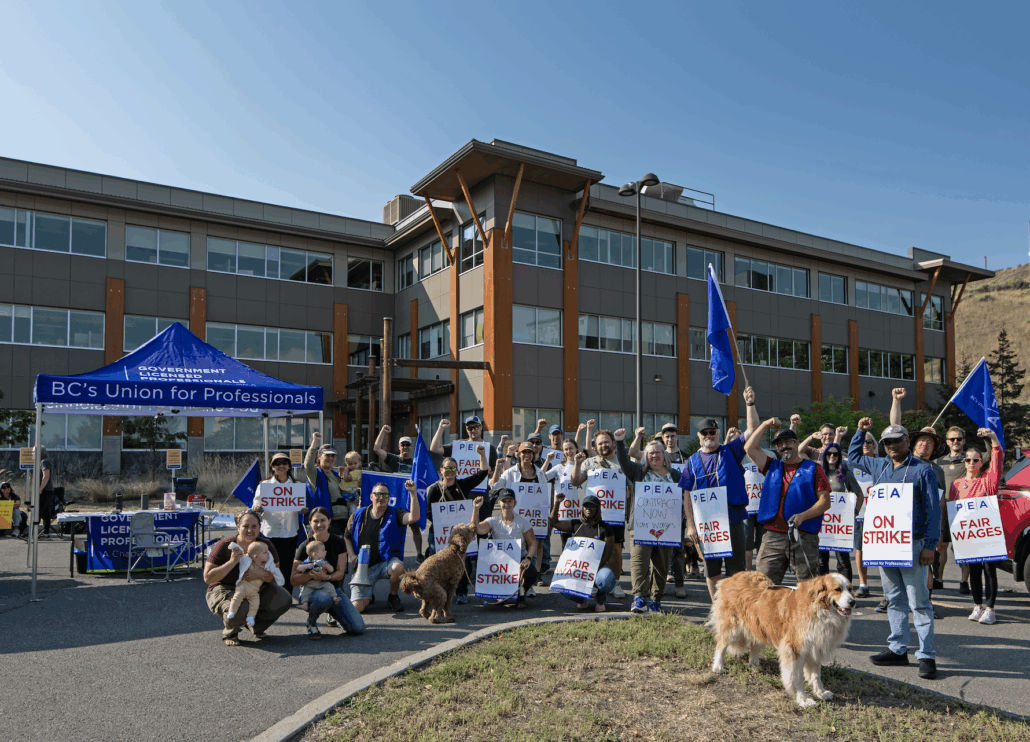
September 16-24 Escalating Pressure
Alongside the BCGEU, we announced that all licensed professionals in the Ministry of Mines and Critical Minerals were on strike. Escalation then continued with Ministry of Transportation and Transit engineers and Ministry of Water, Land and Resource Stewardship members joining picket lines. CUPE members at the downtown Victoria library branch refused to cross our picket lines and supported our efforts. The Union of BC Municipalities convention was held in Victoria and the PEA leafleted the event to raise public awareness.
September 26–29: Solidarity Press Conference
The BCGEU held a major solidarity press conference at the Royal BC Museum with unions leaders from the HEU, FPSE, HSA and PEA joining and at conference, announced they were returning to bargaining. Unfortunately, the PSA only brought 0.5 per cent more to the BCGEU bargaining table, and so job escalation continued.
October 1–2: Vancouver Fund the Frontlines Rally
New picket lines went up across BC in various ministries and locations, including the Ministry of Environment and Climate Strategy. A massive joint rally in Vancouver drew thousands of supporters, activists and BCGEU and PEA members who were on strike.

October 6: 10,000 Member March to the BC Legislature
More than 10,000 PEA and BCGEU members and supporters marched to the BC Legislature — the largest rally of the strike. On this day the strike escalated to include all members in Southern Vancouver Island, including government civil lawyers.
October 7–8: Escalation Continues
The remaining members from the Ministry of Water, Land and Resource Stewardship joined the picket lines, the PEA Flying Squad launched, and all remaining members from the Ministry of Transportation and Transit joined the strike. Over 1,000 GLP picketers were on lines at this point, and the number of BCGEU members exceeded 25,000.
October 14: PEA March
The PEA held a solidarity march with the bargaining committee to the Delta Hotel in Victoria, where negotiations were taking place. However, the PSA did not budge from their initial offer of 3.5 per cent over two years, and talks broke down quickly.
October 16-17: Full Provincial Escalation
We held a major press conference in Victoria announcing a full province-wide strike of all remaining members. This meant that over 1,600 GLP members were now on the picket line. That afternoon, the BCGEU was asked to enter into non-binding mediation with the PSA. During this time, members from both unions in Nelson marched from the picket to the office of the local MLA.
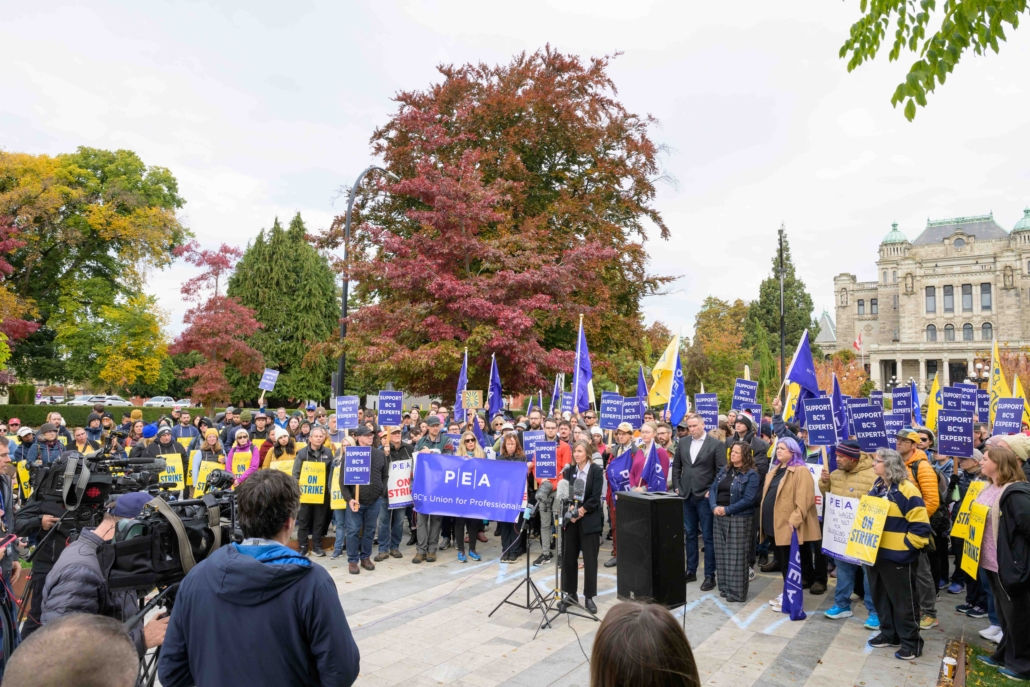
October 18–25: BCGEU Mediation
The BCGEU entered mediation with picket lines from both unions remaining up. Anticipating a BCGEU deal, the PEA bargaining committee travelled to Vancouver and made their presence known at the same hotel where talks were underway. On October 24 we continued our strike escalation by filing an application for allied picketing at the Pattullo Bridge replacement project, while members of the PEA Flying Squad joined the BCGEU to rally and chant outside an NDP fundraiser in Victoria attended by government ministers.
October 26: BCGEU Announces Tentative Agreement
The BCGEU reached a tentative agreement, and the PEA reached a return-to-work agreement after the four-year term of 3 per cent general wage increase each year was confirmed. Improvements to benefits, increases to professional fees, and repayment of lost seniority, sick leave, vacation and overtime, shift and standby work were also confirmed as part of the return-to-work agreement. Picket lines came down for both unions.
November: Negotiations Continue
As the time of writing, the PEA bargaining committee had returned to negotiations with the PSA, but many key issues remained unresolved, including retention and recruitment adjustments, fair compensation for emergency work and a modern classification system that values experience and expertise.
Since a tentative agreement was not reached by November 25, 2025, the PEA now has the right to resume strike action.
- Share:
King's Coronation Medal Recipient
Donna Holmwood, a beloved educator at St. Margaret’s School in Victoria, BC, has been awarded the prestigious King’s Coronation Medal. This national honour commemorates the Coronation of His Majesty King Charles III and recognizes Canadians who have made a significant contribution to their community or country. The medal is not simply a nod to years of service; it is a celebration of Donna’s extraordinary impact as a mentor and leader. It also recognizes the positive impact she has had on the lives of students and colleagues at St. Margaret’s.
Donna is not one to seek the spotlight. In her own words during the medal ceremony, she humbly deflected the honour back to her students and colleagues:
“This recognition is not a personal achievement but a reflection of the incredible individuals I have had the privilege to work alongside—especially the students who embody the spirit of service, leadership, and sense of community every day.”
Through her stewardship of the Duke of Edinburgh Award program at St. Margaret’s, an initiative she once participated in herself as a student, Donna has helped countless students discover their own capacities for leadership, resilience and service. She connects their personal growth to the school’s motto, Servite in Caritate (Service with Love), and exemplifies it in every role she takes on. Her colleagues paint the picture of someone whose influence is felt in both quiet, everyday moments but also as a larger and more enduring legacy. Whether it’s organizing scorekeepers for a sporting event, crafting leadership projects or just being a calm sounding board, Donna is the person people go to for support and encouragement.
Nancy Pekter, a long-time colleague and friend, remarked during the ceremony: “Unlike so many in this world, her leadership is genuine and true, and not often caught on camera but she helps in big ways and small ways, each and every day.”
Students at St. Margaret’s don’t just learn from Donna Holmwood—they learn because of her. She helps them believe that their voice matters, that their contributions make a difference and that leadership comes in many forms.
“Everyone at St. Margaret’s School listens and learns from Donna,” says Bev Waterfield, a fellow teacher and SMS Chapter Chair. “Even though she may be unaware of her influence, she can critically look at an activity or project through the eyes of a student, and her genuine delight when they succeed is contagious.”
The King’s Coronation Medal recognizes individuals who exemplify the best of Canada through service, achievement and commitment to their communities. Donna is a perfect reflection of that honour and her legacy is one of excellence, lived values, and a profound impact on the people around her. And at St. Margaret’s School, her legacy will continue to inspire generations to come.
- Share:
2025 Scholarship and Bursary Recipients
A total of 204 scholarship applications were received and those that met the eligibility criteria were entered into a random draw. This year, the awards committee was pleased to give 20 scholarships to PEA members and their relatives who are seen here.
Andrew Bae, Casey Isaak, Celina Dallow, Charlotte Caswell, Emily Rolston, Fiona Girard, Holly McKenzie, Jack Oliphant, Leif Richter, Madeline Palmer, Mello Di, Noah Ayles, Paula Mali, Reed Murdoch, Sean Guldin, Shayla Mardell, Stephanie Royan, Rhys Tuohy and Willem Rabourn.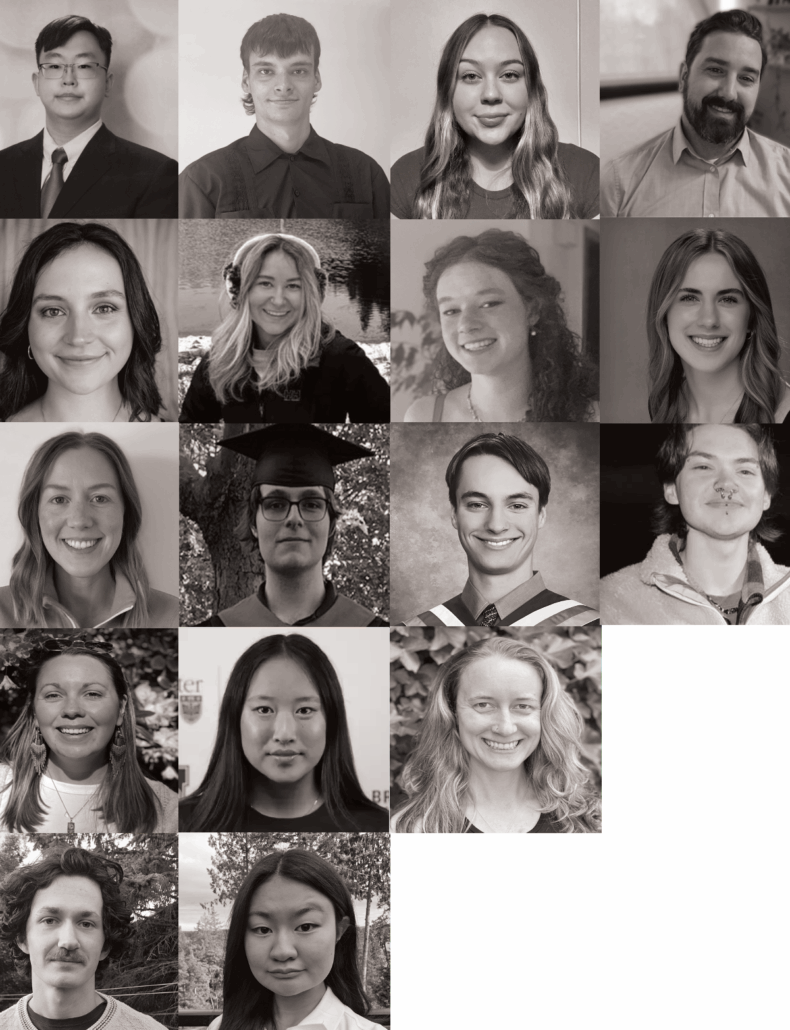
In addition, 20 bursaries of $500 each were given to the following members: Alex Berthin, Annpreet Khangura, Emily Boulter, Jennifer Giebel, Jennifer Walton, Julia Rogers, Justin Bae, Laurie Adsett, Laura Bolster, Lyle Unwin, Mikko Pomian, Olivia Thoen, Patricia Minor, Rosalynn Record-Lemon, Ryan Kunar, Sarah Sutmoller, Selina Jorgensen, Shelly Cheong, Stephanie Kast, and Yossra Othman.
Applications for the 2026 scholarship and bursary awards will reopen in the spring. For more details visit pea.org/bursaries
- Share:
PEA Updates
In Memoriam
 Joanne Montgomery
We were saddened to hear of Joanne Montgomery’s passing on May 5, 2025. Joanne was a consummate volunteer giving freely of her time and energy over many years. In 2014 when she shifted to semi-retirement she continued working as the local union rep for the Health Sciences Association. In 2000, after leaving work at the Summerland hospital, she became a home health physio and a PEA member, and continued in that regard for the next 15 years. In 2015 she was awarded PEA’s Service Award in recognition of her substantial commitment to the union.
 Alden Habacon
We remember Alden Habacon as a thoughtful, generous professional whose work helped move equity, diversity and inclusion from aspiration to action. Alden worked closely with the PEA on our equity, diversity and inclusion goals, bringing both rigour and warmth to every collaboration. His presentation at the 2023 PEA Education Conference and his contributions to many other PEA workshops were educational and impactful. Alden’s clarity, humility and unwavering commitment to inclusion left a lasting mark on our union. He will be deeply missed, and his legacy will continue to guide our work.
Happy Retirement
Congratulations to longtime GLP local rep and Executive Member Lynda Murdoch who retired at the end of July 2025.
Uvic Chapter Celebrates 30 years
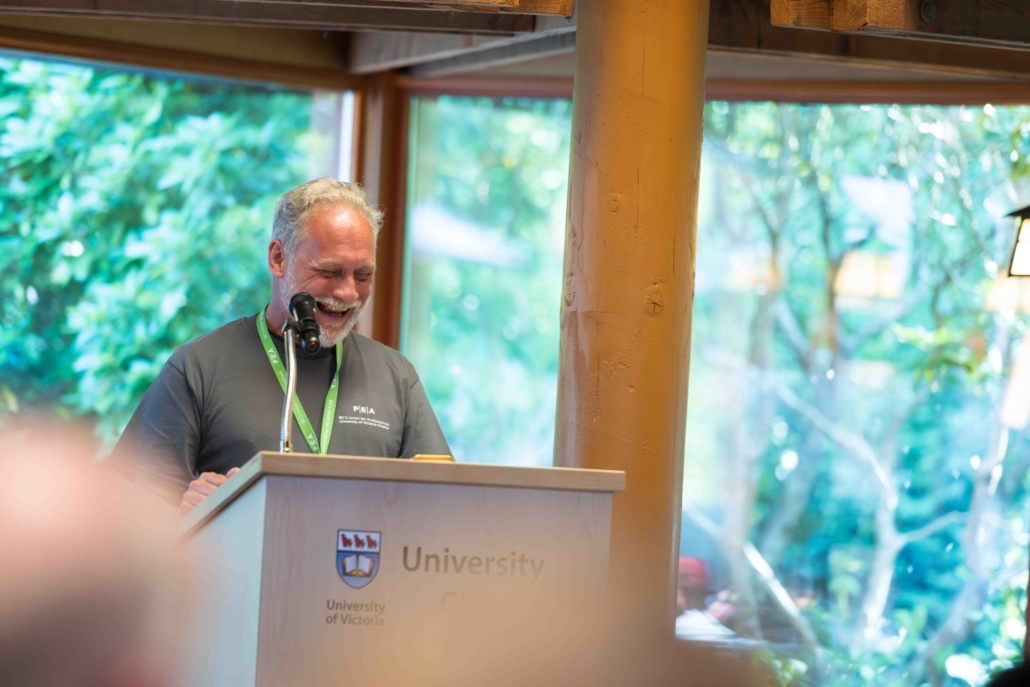
This past summer, members from the PEA’s UVic Chapter celebrated their 30-year anniversary with the PEA by coming together at the University Club on campus
Thanks to everyone who attended the event. Photos: Aaron Lutsch.

- Share:
