
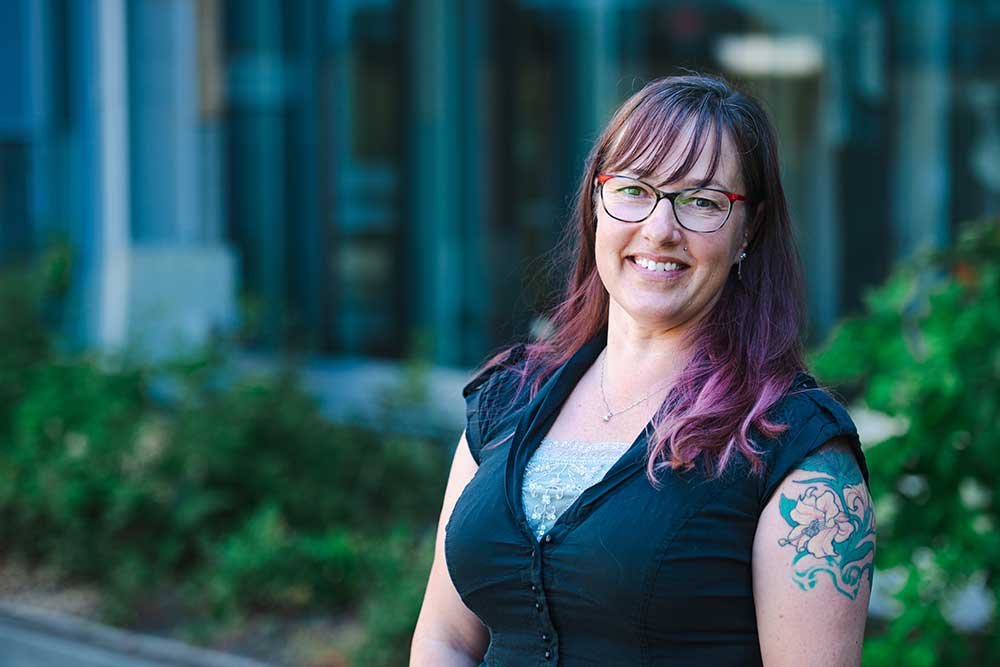
Alina Fisher
Effective Conservation and Restoration
Words by Jessica Natale Woollard
Bad science circulating on social media compelled Alina Fisher to return to academia to help set the record straight.
The UVic Research Manager had completed a bachelor’s degree with a focus on zoology at the University of Alberta in 1997. Soon after, she began a master’s program in environmental biology but paused her studies as she and her husband welcomed two daughters one year apart.
Fifteen years later, the rise of fake news and misinformation in the social media age instigated her return to graduate school, this time with a new focus: science communication.
“My Facebook, Twitter, and Instagram feeds were constantly flooded by pseudo-science—wrong claims that sound scientific,” Fisher explains. “I thought, why don’t I try to do some work that figures out why this is going on? Why this is so prevalent?”
In 2017, Fisher completed the master’s program in professional communication at Royal Roads University, where she was a finalist for the Governor General’s Gold Medal for her work exploring how social media messaging affects the public’s understanding of conservation issues.
Two years later, she began her PhD in environmental studies at UVic. Her doctoral research straddles two worlds—natural science and the social sciences.
The science communications focus is for scientists, she notes.
“Those of us in the sciences, we’re excited about things we do, but nobody ever taught us how to communicate with people who aren’t already in our field,” she says.
It’s territory Fisher is amply qualified to chart.
Not only does her PhD fuse science and science communications, it also incorporates her role at UVic as a manager of environmental research projects.
In 2004, Alina and her partner moved from Alberta to Victoria, where Fisher’s husband, Jason, was a PhD student (he is now an adjunct professor in the department of environmental studies). That same year, she joined the staff at UVic, beginning in Research Services then moving into her first PEA position as a project manager at the Laboratory for Automation Communications and Information Systems Research.
In 2008, she made a key professional move: she accepted a new PEA position, this time as a part-time research manager in the environmental studies department—the same department she is now a PhD candidate in.
In this role, Fisher has her fingers in many different pots. She works with the faculty on grant administration, starting from the preparation of grant applications and the hiring of researchers (students and non-students alike) to the purchasing of specialty equipment needed to do the work. She also helps collect, manage and analyze scientific data resulting from the research, and prepares it to be shared with the granting institution and the scholarly community.
The very first project she worked on—and one she continues to be involved with—has informed part of her doctoral research. The Mountain Legacy Project is an online archive of historic survey and contemporary repeat photos of the
Canadian Rocky Mountains, designed with the objective of demonstrating changes to the landscapes over time. The project team is in the process of retaking some 120,000 original surveyor photographs—many dating as far back as the 19th century—of the Alberta and BC Rockies as well as coastal BC.
Examined side-by-side, the historic photo and the repeat photo give researchers a better understanding of climate change and other ecological processes over time, and can inform what kind of restoration work may be effective.
Fisher notes that the changes visible in the contemporary photos compared with the historic ones are stunning. “You can see the effects of climate change on the treeline and glaciers, and the effects of having eliminated cultural burning by First Nations. A lot of the forests have infilled. They used to be much more open, but now, without the cultural burning that used to take place, they are just jam-packed. Jasper, for example, is shocking.”
Fisher’s thesis has two parts. One focuses on wildlife that inhabit the eastern slope of the Canadian Rocky Mountains, investigating where they live and in what numbers, and how they are responding to landscape changes caused by factors such as climate change and development.
The second part focuses on the social science and communications aspects of this subject. How do the people who reside in these areas perceive current efforts toward species conservation and the restoration of species? Are there differences in attitude between people who live in the region compared with those who don’t?
“I’m hoping my research is going to help inform more effective conservation and restoration where wildlife are concerned,” Fisher says.
In addition to studying photographs, she will conduct focus groups to speak with people about their perceptions of the effectiveness of conservation and how it has impacted those who live near and around wildlife.
This is the one area of her research that was affected by the COVID-19 pandemic. For the most part, her work and studies continued as usual during the lockdown, only from home instead of in the office or classroom. But the restrictions prevented her from traveling to the Rockies to meet with her focus-group participants in person, an inconvenience that delayed her work by about a year, she estimates.
If anyone can make up for lost time, it’s Fisher. She is the type of person who gets things done. She sets her schedule and sticks to it, delivering on time and never asking for accommodation. Without hesitation, she will restrict her own free time in order to be there, in full, for her teen daughters, her family, her work and her education.
“Apparently I thrive on being ridiculously busy,” she laughs, adding that her time-management skills were honed in part while completing the project management professional (PMP) designation during the early years of her career at UVic.
Throughout her PhD studies, she has not asked for extra days off from work and uses vacation days when her research requires time away. She knows her department would support her if she needed an accommodation, but thus far she hasn’t.
“I work with amazing people,” she says. “My department is really collegial, and they support my work and the fact that I have this dual role—both as an employee and a student.”
Significantly, her family has also supported her continuing education. When she was preparing for her doctoral comprehensive exams and needed to study all day every day for an extended period, her husband took over primary care of their daughters. The girls understood that their mom had important work to get done. Fisher passed her exams, thanks to their support.
Fisher has only one time-management trick to share, and it’s about intentionality: be mindful and present, no matter what you’re working on. “It’s making sure I’m not being piecemeal, because then it feels piecemeal all the time,” she explains.
As another school year kicks off, and another round of collective bargaining begins for the UVic PEA chapter, Fisher expresses gratitude for the support of her employer and union.
“I have been so impressed with what has been done by those involved with collective bargaining,” she says. “I’ve gone through it a number of times; I’ve never been unhappy with the outcomes.”
This fall, she’ll also be teaching a class on science communication. The enrolment numbers show how quickly this emerging field is growing: the course was full within a week of opening.
With the vast amounts of science news—real and fake—flooding social media, Fisher and her colleagues in the scientific community have their work cut out for them.
“I believe that misinformation spreads because it touches us deeply; it creates an emotional connection. Whereas science is stated matter-of-factly, and hence only exciting to us scientists,” Fisher explains.
“In part, scientists need to learn how to communicate clearly (without jargon) and connect with our target audiences (to allow that emotional connection). But also, science communication scholars can help people understand how misinformation may be targeting them to manipulate them to spread it.”
Adds Fisher, “I don’t think we’ll ever be free of misinformation on social media, but I’m hopeful that we’ll learn how to inoculate people against it.”
See the article in the Professional, Fall 2022
