Menu Toggle

I want to...
Message From the President
PEA members have voted in favour of increasing union dues from 1.00 per cent to 1.45 per cent, marking the first dues increase in our union’s history.
I want to thank everyone who participated in the referendum and contributed to the discussions leading up to the vote. This was an important decision, and one that members approached with considerable thought. The increase represents a significant commitment by our membership to ensuring the PEA has the resources necessary to provide effective representation, protect our collective agreements, and respond to the challenges we will face in the years ahead.
Central to this decision is the understanding that we are one union. While our chapters represent members working in different professions and workplaces, we share a common interest in maintaining a strong and effective association. The solidarity demonstrated during the Government Licensed Professionals’ eight-week strike was a clear example of this principle in practice. That same commitment to one another will be essential whenever a chapter faces significant challenges, including the possibility of future job action.
The Association Executive recognizes the responsibility that accompanies this increase. Members have agreed to contribute more to their union, and it is incumbent upon us to ensure those additional resources are managed responsibly and directed where they are most needed. Our priorities will include maintaining strong representation and member services, addressing the increasing demands of grievances and other workplace matters, and rebuilding our strike fund to ensure we are prepared to support members when necessary.
Equally important is our responsibility to remain transparent and accountable. We will continue to communicate openly about the PEA’s finances, our priorities, and the decisions we make on behalf of members.
I appreciate that members brought different perspectives to this discussion, and I want to thank everyone who took the time to consider the proposal, ask questions, and participate in the vote. Regardless of how individuals voted, we move forward together with a shared interest in the strength and future of our union.
Cliff Haman
President
- Share:


Secretary-Treasurer Message
The past year was one of the most significant in the PEA’s history. Our membership continued to grow, we supported members through a major public sector bargaining round and, for the first time in over 50 years, our union relied heavily on our defence fund during an eight-week strike.
In 2025, approximately $5.9 million was transferred from our investments to support the strike and other union activities. Those resources allowed members to remain united on the picket line and helped achieve improvements that benefited PEA members across the public sector. Using the defence fund for its intended purpose significantly reduced the value of our investments; however, the portfolio returned 12.08 per cent during the year, exceeding its benchmark.
Our operating costs also continue to increase. The PEA represented more than 4,200 members by the end of 2025, which is an increase of almost 900 members over the last two years. As our union grows, so does the need for bargaining support, grievance representation, legal services, organizing and communications. Membership servicing expenses rose in 2025 as staff responded to more grievances, complex labour relations matters and prolonged disputes that involved PEA legal counsel.
The PEA remains committed to responsible financial oversight and continue to look for ways to reduce costs that will not have a significant impact of member servicing. The Association Executive reviews budgets and expenditures each month, while investment performance and benchmarks are reviewed quarterly.
The complete 2025 financial report and audited statements are available on the PEA website and reflect a year that saw the PEA use our financial resources to support members when they needed them most. Our focus now is now on rebuilding the defence fund, maintaining strong member services and ensuring the union remains financially prepared for future rounds of bargaining.
I would like to thank the Association Executive, PEA staff, our investment advisors at Raymond James, our auditor at Baker Tilly Victoria for their work throughout an exceptionally demanding year. I also want to recognize Marc Joly, who retired in January 2026 after nine years as the PEA’s Financial Officer, and welcome Jennifer Bond to the role.
Thank you for the trust you have placed in me to help steward our union’s finances.
Dwayne Anderson
Secretary-Treasurer
Review the union’s financial statements: pea.org/about-us/financials
- Share:
Making a Difference
HARSHADA DESHPANDE
STAFF LAWYER, PARENTS LEGAL CENTRE VANCOUVER
LEGAL AID BC CHAPTER
Share a bit about your role and the kind of legal work that you do
I work as a Staff Lawyer at the Vancouver Parents Legal Centre (PLC). In this role, I represent parents in child protection matters. Along with our team, I support parents in addressing the protection concerns of the Ministry of Children and Family Development (MCFD) so that they can keep their children safe in their care.
What’s might surprise people about your job?
When I tell people I’m a lawyer, they often assume my days involve dramatic court appearances, like the ones they see on tv. They are often surprised to learn that most of my work is done outside of court. Our program focuses on early and collaborative resolution, so most of my advocacy is done through out-of-court dispute resolution mechanisms like mediations, Family Case Planning Conferences, and other collaborative meetings. Turns out, breaking bread with people does indeed lead to more cooperation.
What drew you to your area of law?
I never even knew about this area of law when I decided to go to law school. The one thing I knew was that I wanted to use my legal education to support women and children who were affected by gendered violence. Coincidentally, Legal Aid BC opened the first PLC in Vancouver just when I graduated from law school and my mentor at the time, Vicky Law, encouraged me to apply to work there. I then had the privilege of articling at the PLC, and learning from experts in the field, who taught me how invaluable parents’ counsel can be in child protection matters. They’ve been my bosses at Legal Aid BC for almost a decade now.
Why does your work matter to the people, communities or public services you support?
The work parents’ counsel do is critical to ensuring that families have the knowledge and advocacy they need to actively participate in making decisions for their children. Our job is to empower parents so that their voice can be heard and taken seriously in a system that often makes them feel powerless.
The work we do helps keep the MCFD accountable for the decisions they make, given the immense power they have. I always say my goal is simple. I want every client that leaves my office to feel like they have the information they need to make the best decision for themselves and their children.
How does being part of the union support you?
Being part of the union gives me the comfort of knowing that I am not alone when the battle gets challenging. Within our own Legal Aid BC chapter, our members are spread out across various locations in the province. Often, it can become isolating and frustrating. Being a part of the union reminds me that I have a community of support and a wealth of knowledge I can draw on when I need it. And in turn, I can use my experience and knowledge to support my colleagues in their work.
Having access to the wider PEA collective helps make our workplace better in more ways than I can count. I’ve had the pleasure of representing my colleagues at the bargaining table multiple times, an experience that has helped us all seek continuous improvements to our collective agreement, which helps us serve our clients better.
I’ve lost track of the number of trainings and seminars I’ve been able to attend through the union, not to mention the one-on-one guidance I’ve received through our fabulous PEA labour relation representatives.
LAWYERS
FAMILY MAINTENANCE AGENCY
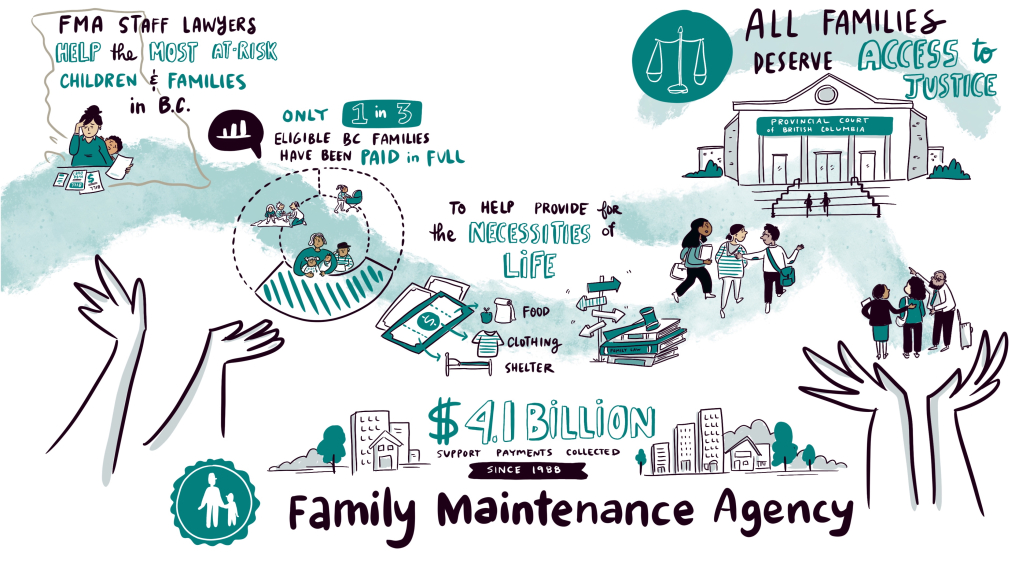
Lawyers at the BC Family Maintenance Agency (FMA) help ensure that child and spousal support orders are followed. They advise staff, prepare enforcement cases, work with external counsel and appear in Provincial and Supreme Courts across British Columbia. Because of the sensitive and serious nature of their enforcement work, this group of lawyers is being profiled as a group as they cannot be identified publically.
The work of FMA lawyers often involves unpaid spousal support, financial disclosure, income or asset enforcement, licence suspensions, warrants and cases that cross provincial or international borders. They work closely with case managers, payment specialists, legal assistants and client-service staff.
One thing that may surprise people is that these lawyers do not represent either the person paying support or the person receiving it. Their role is to help it administer and enforce support orders fairly, lawfully and effectively on behalf of the FMA.
Court action is not always the first step and FMA attempts to establish voluntary payment arrangement and use administrative enforcement tools before beginning legal proceedings. FMA lawyers help determine which approach is appropriate based on the circumstances of each case.
Their work is incredibly important. Child and spousal support ensures that families are able to afford housing, food, education, transportation and other essential expenses. By helping enforce support orders, these PEA members contribute to access to justice and confidence in the family justice system.
- Share:
Are You Convention Curious?
The PEA Convention is one of the most important events in our union. It takes place every three years and brings together delegates from chapters across the province to make decisions about the future of the PEA.
Each chapter sends delegates based on its membership size, and members of the Association Executive attend as delegates as well. Together, delegates discuss and vote on key issues that shape the direction of the union.
Convention is where members have a direct voice in decisions about:
- Strategic goals, priorities and governance
- Changes to the Constitution and Bylaws
- Financial matters
- The election of the union’s table officers
But Convention is about more than votes and resolutions. It is also a chance to meet members from different workplaces and professions, learn about the issues they face, exchange ideas and build connections across the union. Many delegates leave Convention with a stronger understanding of how the PEA works and how members can make a difference.
What Gets Debated at Convention?
Convention is driven by PEA members. Before Convention, members can submit resolutions for delegates to consider. A resolution is simply a proposal that asks the union to take a position or action on a particular issue.
Resolutions can cover a wide range of topics, including:
- Union priorities
- Constitutional and bylaw changes
- Financial and fiscal matters
- Workplace and social issues that affect members
Any member can submit a resolution, provided it has the support of at least one other member and is submitted by the deadline. Chapters and the Association Executive can also submit resolutions.
During Convention, delegates debate the resolutions, hear different viewpoints and vote on whether they should be adopted. Delegates also vote to accept the auditor’s report and financial statements.
In some cases, new resolutions can be introduced during Convention itself. These resolutions from the floor require the support of two-thirds of delegates before they can be considered.

How Are Resolutions Reviewed?
To help delegates work through the resolutions, a Resolutions Committee reviews all submissions before Convention. The committee is made up of:
- The First Vice-President, who serves as chair
- One additional member of the Association Executive
- Two convention delegates
Before Convention begins, the committee reviews every resolution. Similar resolutions may be combined, and wording may be adjusted to improve clarity. The committee then provides recommendations to delegates, who make the final decisions through debate and voting.
If a resolution has financial implications for the PEA, it is also reviewed by the Ways and Means Committee. This committee is chaired by the Secretary-Treasurer and includes one other executive member and two delegates.
The committees help organize the work of Convention, but it is the delegates who ultimately decide the outcome.
Most Resolutions Have Two Parts
The “Why”
The first part is called the preamble. This section explains why the resolution is being proposed and provides background information or context.
Preambles usually begin with the word “Whereas” and may include several statements outlining the issue, concern, or opportunity the resolution is meant to address.
Not every resolution includes a preamble, but when it does, it’s often the best place to understand the reasoning behind the proposal.
The “What”
The second part is the motion, which is the action being proposed. Every resolution must include a motion. This section begins with the words “Therefore be it resolved” and sets out exactly what delegates are being asked to approve. In other words, it describes the policy, position, or action the resolution would direct the PEA to take.
Table Officer Elections
Table officers are elected by delegates at the convention of the PEA for a three-year term.
The chair will not call nominations for subsequent positions until each position is filled. The chair will call nominations for each position three times. After nominations close, the chair will ask each of the nominated candidates if they are willing to accept the nomination. If only one nominee is prepared to accept nomination, they will be declared elected. If there is to be an election, each nominee or nominator will be given five minutes to speak to Convention.
The Sergeant-at-Arms Committee will verify the online voting platform and the results will be tabulated by the virtual voting platform and provided to delegates.
A candidate must have a clear majority of votes to be successful. If there are more than two candidates for the position and on the first or any consecutive ballot there is not a clear majority, the candidate with the fewest votes will drop off and the vote will be conducted again until a candidate has at least 50 per cent plus one of the votes.
No election materials, such as leaflets, posters, buttons or banners will be distributed or displayed in the venue or any other room where the business of convention is being carried out.
Table Officer Roles
All four of the PEA Table Officer roles are elected by delegates at Convention for a three-year term and can be re-eleted to serve additional terms.
President
As the public face of the union, the President chairs meetings of the Association Executive and Convention, helps guide the work of the union’s committees and represents PEA members in discussions with labour organizations, employers and other stakeholders. The President also serves as an official signing officer for the union and works with the Association Executive to carry out the priorities and decisions set by members.
Two Vice Presidents
The Vice-Presidents play a key leadership role in supporting the President and helping guide the work of the union. When the President is unavailable, a Vice-President steps in to chair meetings of the Association Executive and Convention and carry out the President’s responsibilities.
In addition to their leadership duties, the Vice-Presidents oversee several important areas of the union’s work. The First Vice-President chairs the Staff Relations Committee, while the Second Vice-President chairs the Education Committee. Both Vice-Presidents also serve on the Finance and Investment Committee, helping oversee the union’s financial health and long-term planning.
Secretary-Treasurer
This role helps ensure the PEA remains financially strong, accountable and transparent to members. The Secretary-Treasurer oversees the union’s financial records, investments and reporting processes, helping safeguard members’ dues and ensuring the Association’s finances are managed responsibly.
The Secretary-Treasurer chairs the Finance and Investment Committee and is responsible for ensuring that audited financial statements are prepared and presented to Convention. The role also helps maintain important governance records, including membership records, meeting minutes and official notices.
- Share:
Labour Of Love
Sunshine Gudlaugson was in a hospital cafeteria in the Lower Mainland when a casual employee approached her with a concern about a recent pay stub. A staff representative for the Hospital Employees’ Union (HEU) and a member of the PEA’s Hospital Employees’ Staff Union (HESU) chapter, Gudlaugson likes to be visible to the people she stands for, for exactly these kinds of moments.
The casual said they’d noticed they’d been paid less after being sick. “I said, ‘Really? Tell me more,’” Gudlaugson recalls, her intuition telling her something very big wasn’t right. That chance encounter in the cafeteria led to a major investigation of casual sick pay at health authorities across British Columbia. After crunching countless numbers, Gudlaugson and her colleagues uncovered what they believe to be a significant oversight: every time a casual uses one of their five allotted sick days per year, they are being paid their hourly wage but not their percentage in lieu of vacation. “All of [the casuals] get paid using the same formula,” Gudlaugson explains. “[The employer] has been underpaying every single casual by 13%, for five days a year, since 2022, at every single health authority in the province.”
By being present and following her curiosity, Gudlaugson teased out the thread that is unravelling this knot encompassing thousands of workers. Her natural affability and inquisitiveness have made her a force for good in the labour movement since she entered it almost by chance in 2011. Gudlaugson, who holds bachelor’s and master’s degrees in English literature, worked first in higher education and then moved into the BC Government. In 2010, she was a member of the BC General Employees’ Union (BCGEU) doing frontline intakes for income assistance. One day, she tried to approach her shop steward with a question and discovered her unit did not have one. What else could Gudlaugson do but take on the role to represent her colleagues?
The following year, she was seconded to the BCGEU to work as a union representative, and it was there she found a new career in labour. In 2014, she took a position at the Burnaby-based HEU, which made her a PEA member in the HESU chapter. HEU represents 60,000 health care workers across British Columbia, from care aides, food service workers, and cleaners to lab assistants, nursing unit assistants, and home support workers in community and residential care settings. She advocates for workers in grievances and collective bargaining with skill, intelligence and heart, all of which are on display when she shares her many work stories, especially those about leaves and money, which have become a speciality of hers.
Reflecting on the coincidental way she got involved in labour, Gudlaugson observes that “the world is run by the people who show up. When someone shows up, they get assigned work.” Examples of showing up—and taking on unexpected roles—are speckled throughout her personal and professional life. When her two daughters registered for Girl Guides and no guide leader arrived? Gudlaugson took on the role. When two non-profit daycares needed board members? Gudlaugson raised her hand and helped them get on the $10/day childcare program. When a casual colleague needed a kidney to save her life? Gudlaugson donated one of hers.
“If that were you, you would have wanted someone to step up, right?” she asks. The kidney donation was successful, and Gudlaugson and the donor recipient—now friend—celebrate together every year with a steak dinner. Because of this life-changing experience, Gudlaugson tries to negotiate donor leave into the collective agreements she touches. Hers with the BCGEU had a provision for leaves for organ and bone marrow donations, which meant she didn’t have to worry about finances while making her organ donation. Recently, she was the initial impetus behind negotiating an organ donor provision into the collective agreement of the Health Sciences Professionals Bargaining Association, which represents more than 20,000 health care professionals such as medical laboratory and imaging technologists, physiotherapists, social workers, respiratory therapists and pharmacists. And, such a provision is now in the collective agreement between the PEA HESU’s chapter and the HEU.
Gudlaugson’s protective nature has her on alert for people who need to be supported and defended. “It’s David and Goliath,” she says of her work in labour. “All of our members, especially our food service and housekeeping staff, are every single David you’ve ever seen.” To illustrate her point, she relates a case from over a decade ago involving a housekeeper at a hospital. The woman was small in stature, as Gudlaugson describes—not five feet tall and less than 100 pounds. One day she was told that instead of mopping floors, she would be doing laundry, which required pushing a nine-foot-high laundry cart weighing up to 350 pounds. When the member told the manager she couldn’t do it, she was sent home for insubordination. Gudlaugson filed a grievance, and ultimately WorkSafe BC ruled that three people were required to safely do the laundry job, not one. “Of course, [the member] got her regular job back,” Gudlaugson adds.
As for the grievance about the missing casual sick pay, it will be going to a hearing in 2026 and could see a substantial return for affected parties. Gudlaugson, however, will be following the proceedings from a small town in the south of France. Thanks to a provision in the HESU collective agreement, she is on sabbatical and will be enjoying a year abroad with her husband and teen and pre-teen daughters. Her goals for the year are to enroll in cooking classes, take conversational French classes, eat croissants, and write a science fiction book. “I’m going to live my best life,” she notes with a laugh.
No doubt, pastry in one hand and pen in the other, she won’t be able to stop herself from taking notes on France’s active labour movement, looking for ways she can help health care workers in BC upon her return. Gudlaugson adds, “I really like my job. It’s fun to always be the good guy.”
- Share:
PEA Updates
2026 Scholarship and Bursary Recipients
For over 30 years, the PEA has been giving scholarships and bursaries to PEA members and their families.
A total of 204 scholarship applications were received and those that met the eligibility criteria were entered into a random draw. This year, the awards committee was pleased to give 20 scholarships to PEA members and their relatives:
Abdulaziz Al-Rubaye, Madeline Astridge, Rebecca Black, Annika Bonell, Robert Boweker, Nicholas Cayla, Mackenzie Clarke, Claire Dunn, Kaiya Forbes, Michael Ghazarian-Leeson, Harper Gordon, Olive, Hennings-Gauld, Sierra Macdonald, Ash Moosavi, Keely O’Neill, Hazen Platt, Catriona Richardson, Elvy Braun Ridsdale Natalie Sebel, and Syvie Watson.
In addition, bursaries of $500 each were given to the following members: Kendra Allen, Dean Bright, Sondoss Elnegahy, Nicola Enderud, Denneisha Griffin, Cong Huang, Chloe Johnston, Josie Kozack, Felicya Lau, Julie Maxwell, Caitlyn Murphy-Eagleson, Daniel Nair, Lydia Pengilley, Spencer Percy, Janna Sullivan, Lori Wade, Nancy Wang, Julianna Wells, and Paula Wray.
Applications for the 2027 scholarship and bursary awards will reopen in the spring. For more details visit pea.org/bursaries
Strong Ratification Votes Continue
It would be difficult to view these ratification results without acknowledging the impact of the 2025 GLP strike, which helped set a new provincial public sector mandate.
BC Energy Regulator
Members voted 97.3% in favour of the agreement on September 8, 2026.
Legal Aid BC Lawyers
Members voted 96.4% in favour of the agreement on June 23, 2026.
St. Margaret’s School
Members voted 98.7% in favour of the agreement on May 19, 2026.
University of Victoria
Members voted 98.6% in favour of the agreement on June 2, 2026.
Congratulations
The PEA is proud to recognize our long‑serving staff whose dedication and experience strengthen the work of the union. In 2026, Director of Labour
Relations, Brett Harper and Executive Director, Melissa Moroz, both celebrated 15 years with the PEA, impressive milestones reflecting many years of
remarkable service.
- Share:
